
Concrete slab cracks are common, and most of them are not a sign that something has gone badly wrong. Concrete shrinks as it sets and dries, and where that shrinkage is restrained, the concrete is liable to crack.[1] The skill is in controlling where and how much it cracks, and knowing which cracks need attention.
This guide explains the main causes, what joints and curing do, what the Victorian guide says about slab cracks and when to get a professional in. We build slabs to your engineer’s drawings and do not print prices here.
Related reading
- Our service: Concrete Slabs
- Our service page: Concrete Slabs Melbourne
- Related guide: How Concrete Slabs Are Priced in Melbourne: A 2026 Builder’s Guide
- Related guide: Raft Slab vs Waffle Slab: What Is the Difference?
Why Concrete Slab Cracks Form
The root cause is restraint. As concrete shrinks, anything holding it back, such as the ground beneath it or the edges around it, pulls against the shrinkage. In members such as slabs on ground, walls or some foundations, the effects of restraint are probable and have to be allowed for in the design.[1]
Plastic
First day
Plastic shrinkage and settlement cracks usually appear within the first day[2]
Thermal
First weeks
Early thermal contraction cracking mainly occurs within a few weeks[2]
Ground
Later
Soil, drainage, trees and leaks can move a finished slab[3]
Plastic shrinkage cracks vary from a hairline to perhaps 3 mm in width.[1] Cracking from early thermal contraction mainly occurs within the first few weeks after casting.[2] After that, cracking is more often linked to what is happening in the ground or the building.
Control Joints and Concrete Slab Cracks
You cannot stop concrete shrinking, but you can choose where it cracks. Contraction joints, sometimes called control joints, create a deliberate line of weakness so that shrinkage cracks form in the joint rather than across the slab. The CCAA guide says contraction joints must be installed in unreinforced concrete at intervals.[1]
The spacing comes from the design, not from a rule of thumb, and it depends on the slab’s thickness, reinforcement and use. We cut or form joints where the drawings show them and at the time the drawings require.
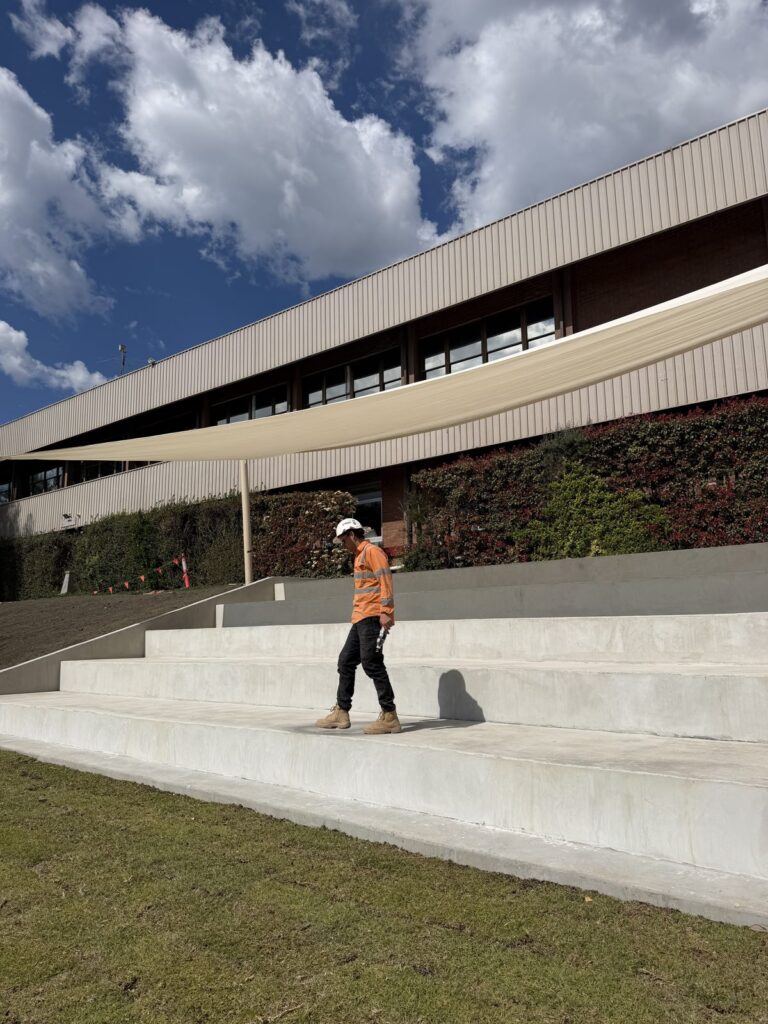
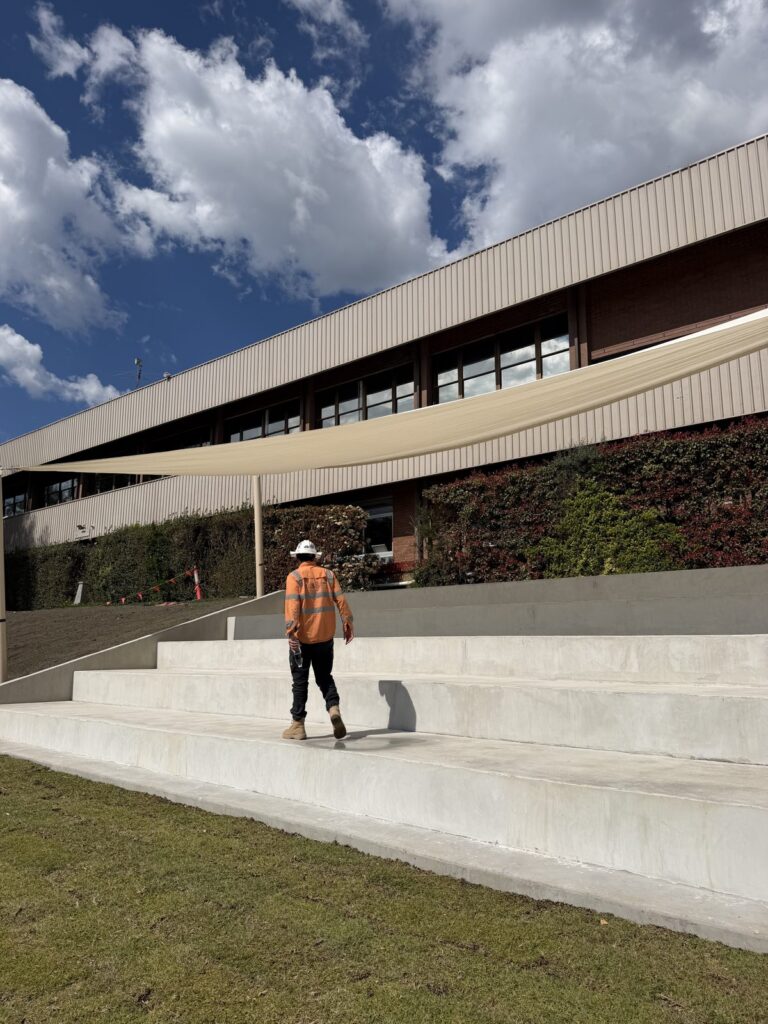
Finished concrete on a Cinerari site. Joint layout is set out on the drawings.
Curing and Concrete Slab Cracks
Curing keeps the concrete moist so it gains strength without drying too fast. The CCAA says adequate protection and curing are the only means of controlling the development of restrained tensile stresses at early ages.[2] Good construction practices that reduce early shrinkage and minimise restraint are essential requirements.[2]
The NCC Housing Provisions set out a clear minimum for slabs in housing: the concrete must be adequately compacted, and slab surfaces, including edges, moist cured for 7 days.[5] On other work, the specification sets the curing method and time.
★★★★★
“They completed the work on time, kept the site clean, and were always happy to answer questions and offer helpful suggestions.”
NO Shops · client review
Reinforcement and Concrete Slab Cracks
Reinforcement does not stop cracks from forming. It holds them tight so they stay narrow. The NCC Housing Provisions give two examples that show how reinforcement is matched to the job: concrete infill slabs must use a minimum of SL62 mesh to control shrinkage, and slabs under brittle floor coverings over 16 m² need SL92 or equivalent throughout the affected area.[5]
| Situation | What the NCC Housing Provisions require |
|---|---|
| Concrete infill slabs | A minimum of SL62 mesh to control shrinkage[5] |
| Brittle floor coverings over 16 m² | SL92 or equivalent throughout the affected slab area[5] |
| Slab curing in housing | Moist cure, including edges, for 7 days[5] |
These are housing rules, so treat them as examples. Commercial, industrial and civil slabs follow the engineer’s design and the specification.
When Concrete Slab Cracks Need Attention
The Victorian Building and Plumbing Commission’s guide gives one clear threshold for slab-on-ground cracks in domestic work. Cracks may be considered outside tolerance if they are equal to or greater than 2 mm in width.[3] Cracks narrower than that should be monitored closely for 12 months once they are identified.[3]
The same guide lists causes to consider, including soil conditions, drainage, trees, plumbing leaks, site works and abnormal moisture.[3] It says to consult a registered building practitioner such as a building surveyor, building inspector or structural engineer.[3] Be careful with the crack tables for walls. The CSIRO crack scale is for walls, and it notes that wall cracking will usually reach the critical point significantly earlier than cracking in slabs.[4]
Monitor and record
- A narrow crack that is not changing
- A crack that formed in the first weeks
- A crack in line with a joint
Get it assessed
- A crack 2 mm or wider in domestic work[3]
- A crack that is growing
- Uneven floor levels or doors that stick
- Cracking with a leak or damp
Questions to Ask About Concrete Slab Cracks Before the Pour
The best time to deal with concrete slab cracks is before the concrete goes in. These questions turn a general worry into something the drawings and the quote can answer.
Where are the joints?
Ask for the joint layout on the drawings, and whether joints are cut or formed.
How will it be cured?
Ask for the curing method and the number of days, and who is responsible for it.[2][5]
What reinforcement is specified?
Ask where the mesh or bars sit and what they are meant to control.[5]
What restrains the slab?
Edges, columns and the ground all restrain shrinkage, so ask how the design allows for them.[1]
What is the ground?
Ask for the site class and the maintenance conditions the design assumes.
Who signs off the pre-pour check?
A recorded check of formwork, steel and levels catches problems that cannot be fixed afterwards.
Concrete slab cracks that appear after a slab was built to a clear design are far easier to assess than cracks in a slab nobody can explain. A paper trail of joints, curing and steel is worth having.
What to Do About Concrete Slab Cracks
Start with the conditions around the slab. If cracking becomes apparent, the site maintenance conditions should be checked, and the fix may include regrading surface drainage, moving gardens and trees or repairing leaks.[6] Fixing the cause before filling the crack matters, because a filled crack will reopen if the movement continues.
If you are planning a new slab, the best time to deal with cracking is before the pour. Ask how joints, curing and reinforcement are shown on the drawings and who is responsible for each. We list what is included in a slab quote so those questions have clear answers.
How We Work With You
1
Talk to us about your scope
Send drawings, slab requirements and site conditions.
2
Confirm plan and pricing
We review the documents and give clear pricing based on scope and site conditions.
3
Accurate delivery
Inspection hold points keep the work accurate, with photo records.
4
Clean handover
The work is ready for the next trade, with a tidy site and clear communication.
Get a Slab Quote for Your Melbourne Project
Cinerari Contracting builds concrete slabs for civil, industrial and commercial projects and selected residential works across Melbourne and regional Victoria. Send the drawings and site details, and we’ll price it.
Are Hairline Cracks in Concrete Common?
Yes. Shrinkage cracks are expected where the concrete is restrained, and plastic shrinkage cracks vary from a hairline to perhaps 3 mm.[1] Most narrow early cracks are not structural, but they should be watched.
When Should I Worry About Cracks in a Concrete Slab?
In Victorian domestic work, a slab-on-ground crack of 2 mm or more may be outside tolerance, and narrower cracks should be monitored for 12 months.[3] Growth, uneven levels or leaks are reasons to call a building practitioner sooner.
Is a Cracked Slab a Big Deal?
Often not, but it depends on the cause. Soil movement, drainage, trees and leaks can all load a slab.[3] Have the cause assessed before deciding.
Can Concrete Slab Cracks Be Prevented?
They cannot be removed entirely, but good practice reduces them. Control joints, curing, reinforcement and limiting restraint are the main tools.[1][2]
How Long Should a Slab Be Cured?
For slabs in housing, the NCC Housing Provisions call for moist curing of the surface, including edges, for 7 days.[5] Other work follows its specification.
Who Should Assess a Cracked Slab?
The Victorian guide points to a registered building practitioner such as a building surveyor, building inspector or structural engineer.[3]
More Concrete and Civil Guides
Read next
Concrete Slabs in Brunswick — Heritage Footprints, Reactive Clay, and Dual Occupancy Builds
Continue reading →
About the author
Luke Cinerari, Director, Cinerari Contracting
Luke leads Cinerari Contracting, a Melbourne civil and reinforced concrete subcontractor working with builders, developers and civil contractors across metropolitan Melbourne and regional Victoria. Cinerari builds retaining walls, footings, slabs, pits, culverts and site establishment works to the engineer’s drawings.
Phone: 0400 692 550 · Email: hello@cineraricontracting.com
Sources
- Cement Concrete & Aggregates Australia, Guide to Concrete Construction, Part V Section 17: Control of Cracking in Concrete
- Cement Concrete & Aggregates Australia, Specifying Low Drying Shrinkage is not Crack Control
- Building and Plumbing Commission Victoria, Guide to Standards and Tolerances 2026
- CSIRO, Foundation Maintenance and Footing Performance
- Australian Building Codes Board, NCC 2022 Housing Provisions, Part 4.2 Footings, slabs and associated elements
- Queensland Building and Construction Commission, A guide to preventing structural damage
Information in the concreting industry changes frequently. Requirements differ by council and by site, and linked content may change or become outdated. Please always contact us for help with your important building decisions.