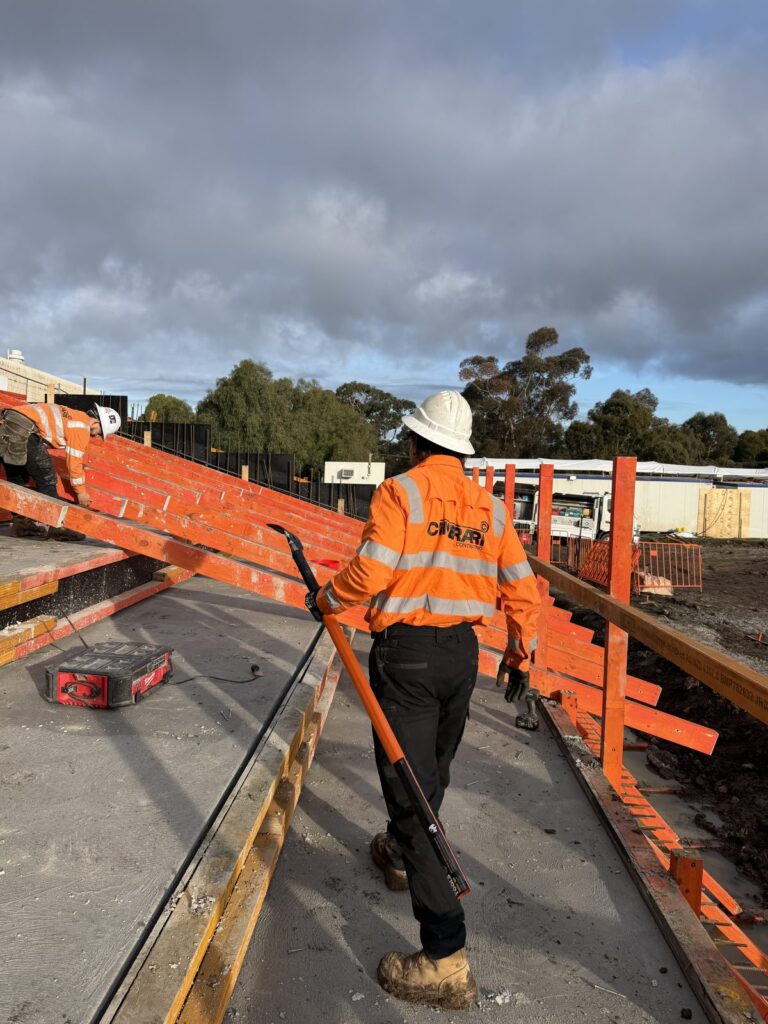

Raft slab vs waffle slab is one of the most common questions on a slab-on-ground job, and the honest answer is that the ground and the engineer decide, not the contractor’s preference. Both are stiffened slabs that sit on the ground and are designed to cope with soil that moves. The difference is mostly in how the stiffening ribs are formed.
This guide explains how each system is built, why the site class matters and where the published sources disagree. We build slabs to your engineer’s drawings and do not design them, and we do not print prices here.
Related reading
- Our service: Concrete Slabs
- Our service page: Concrete Slabs Melbourne
- Related guide: Concrete Slab Cost Melbourne 2026: What Drives the Price
Raft Slab vs Waffle Slab: The Short Answer
A stiffened raft is a concrete slab on ground stiffened by integral edge beams.[5] A waffle raft is a stiffened raft with closely spaced ribs constructed on the ground.[5] Put simply, both are rafts. The waffle version spreads the stiffening into a grid of ribs formed above the ground, and the conventional stiffened raft uses beams that sit in the ground.
Edge beams
Stiffened raft
Integral beams stiffen the slab[5]
Ribs on ground
Waffle raft
Closely spaced ribs formed on the ground[5]
Engineered
Both
Footings are engineered to AS 2870[3]
Waffle ribs are usually formed by laying a grid of void formers on a levelled area and pouring the slab over them.[4] The void formers are what leave the waffle pattern underneath. One teaching source notes that this avoids the problems of beams embedded in reactive clay, which is a point in the waffle system’s favour but not a rule that settles every site.[4]
Raft Slab vs Waffle Slab: Why the Ground Decides
Before either slab can be designed, the site has to be classified. The National Construction Code requires the foundations to be classified in accordance with AS 2870.[1] The classification normally comes from a geotechnical report.[2] The reason is clay. Clay soils are subject to saturation and swell and shrink problems, and the classes describe how much a site is likely to move.[2]
| Site class | What it means | Expected movement |
|---|---|---|
| A | Most sand and rock sites with little or no ground movement from moisture changes[2] | 0 mm[3] |
| S | Slightly reactive site | 0 to 20 mm[3] |
| M | Moderately reactive site | 20 to 40 mm[3] |
| H, E and P | Highly reactive, extremely reactive and problem sites | Engineered design[1] |
The movement figures in the table come from a Queensland Government guide that reproduces the AS 2870 table for home owners.[3] The standard itself is behind a paywall, so we quote the published reproductions. Victoria has a lot of reactive ground: one peer-reviewed paper reports that approximately half of the surface area in Victoria was covered by moderate to highly expansive soils.[5]
How Each Is Built: Raft Slab vs Waffle Slab
1
Classify the site
A geotechnical report gives the site class.[2]
2
Design the slab
The engineer sizes the slab and its stiffening to AS 2870.[3]
3
Prepare the ground
The area is levelled and, for a waffle raft, void formers are laid in a grid.[4]
4
Fix steel and pour
Reinforcement is placed and checked, then the concrete is poured.
The stiffened raft takes its stiffness from beams that are part of the slab, arranged to form an integral structural grid.[6] The waffle raft takes it from the ribs formed between the void formers. In both cases the drawings set out the sizes, the steel and the details at the edges, and the slab is built to them.
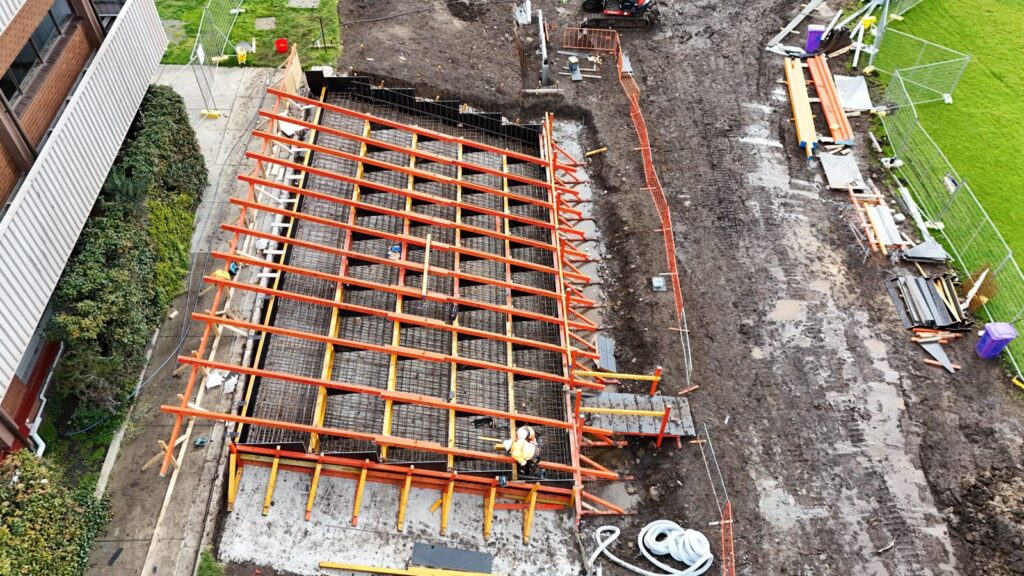
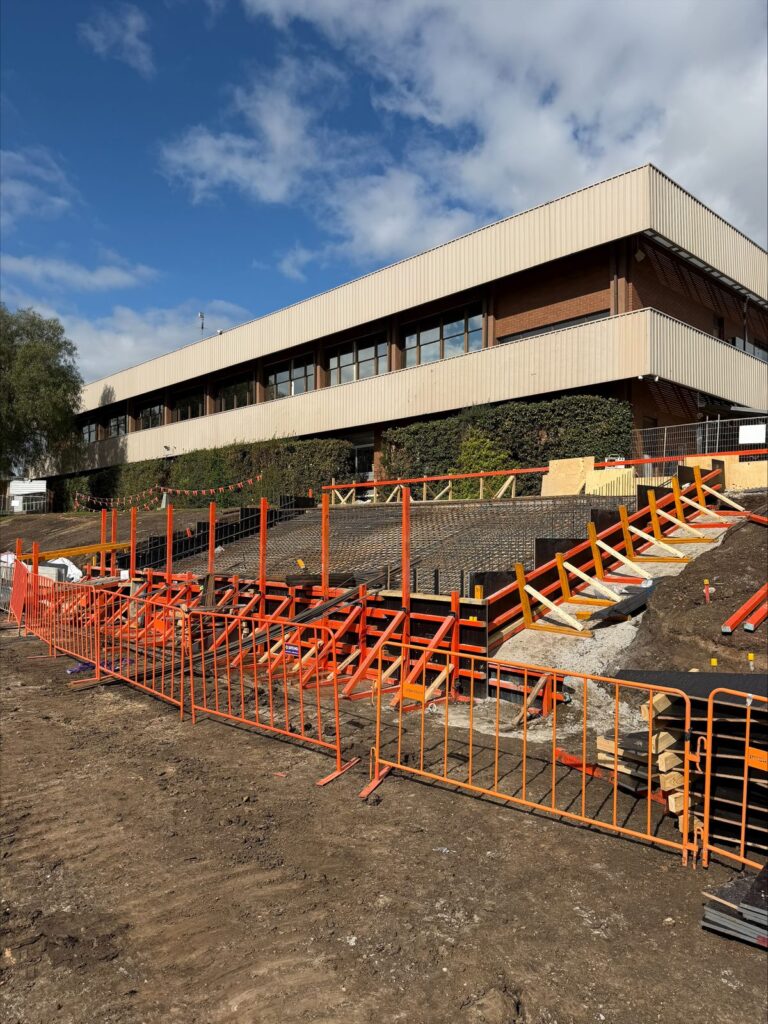
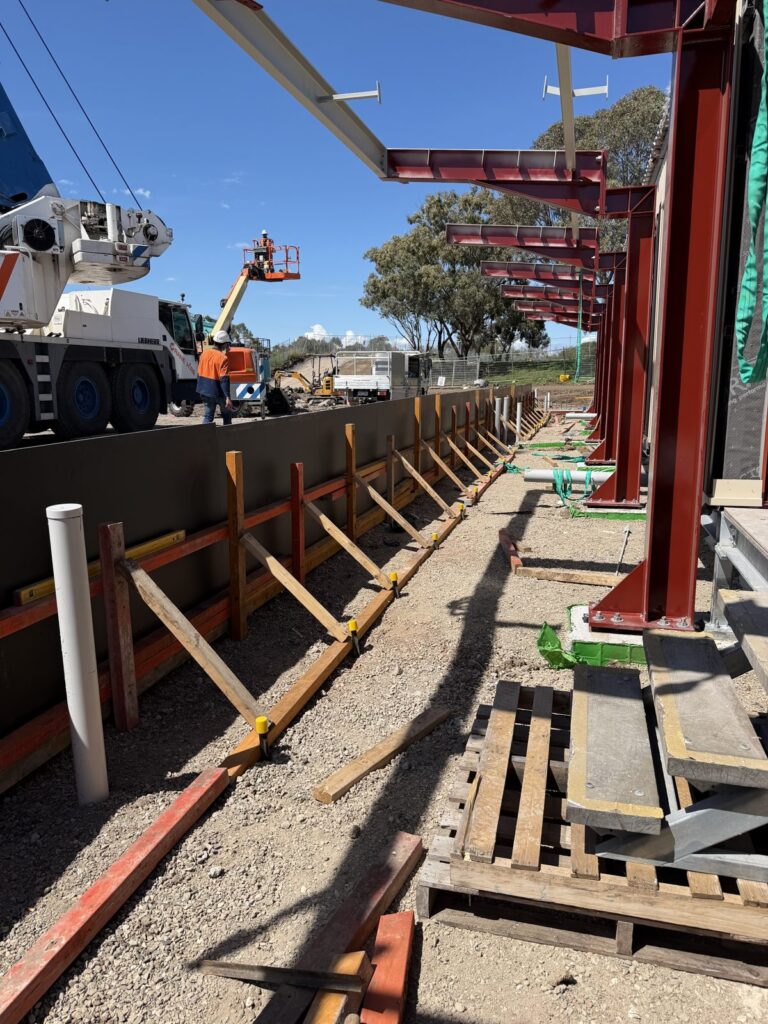
Slab reinforcement and formwork ready for the pre-pour check on a Cinerari site.
Raft Slab vs Waffle Slab: What the NCC and the Engineer Decide
The NCC Housing Provisions include tables for stiffened rafts on Class A, S and M sites.[1] Where a site falls outside that, the Housing Provisions point to AS 2870 and design beyond their scope.[1] In plain terms, a straightforward site can use the tables, and a difficult one needs an engineer to design the slab.
That is why we do not recommend one system over the other in the abstract. A slab is only as good as the match between the soil, the design and the way it is built. We build what is drawn, and we raise anything on site that does not match the report.
★★★★★
“The team was punctual, professional, and very knowledgeable, making the whole process smooth and stress-free.”
nomar group · client review
Raft Slab vs Waffle Slab: Which Is Better?
The published sources do not agree on a single answer, and that is the most useful thing to know. A teaching source from RMIT describes the waffle raft as ideally suited to very reactive clay sites.[4] A university paper says that, under the deemed-to-comply approach, only raft slabs can be used on classes H1 to E.[5] The current NCC sends Class H, E and P sites to engineered design.[1]
What decides the choice
- The site class and the geotechnical report
- The engineer’s design to AS 2870
- The building’s size, loads and layout
- How the slab edge is detailed
What does not
- A rule of thumb from another job
- The cheapest line in a quote
- Which system the last builder used
- A contractor’s habit
Mid-article note
Have a slab design and want it priced? Send us the drawings and we will list what is included and what is not.
Questions to Ask Before You Choose Between a Raft Slab vs Waffle Slab
A raft slab vs waffle slab comparison should always start with the site, not the slab. These are the questions we would ask before any quote is compared, and they apply whichever system the engineer specifies.
What is the site class?
It should be in the geotechnical report, and the design should name it.[2]
Which system is drawn?
The structural drawings show the slab type and the stiffening. A contractor should not swap one for the other.
What drainage does the design assume?
Footings are designed for normal seasonal movement if conditions are maintained.[3]
Are there trees close by?
Trees and poor surface drainage are named as abnormal conditions.[3]
What is included in the quote?
Void formers, steel, formwork, pump and finishing should each be listed or excluded in writing.
Who inspects, and when?
Hold points for the ground, the steel and the pre-pour check should be on the programme.
If a quote offers a different slab to the one on the drawings, ask who has approved the change. A raft slab vs waffle slab swap is a design decision that belongs to the engineer.
Keeping a Raft or Waffle Slab Performing
Footings are designed to accommodate the expected movement caused by seasonal changes in the soil, as long as the site conditions are maintained.[3] The conditions that can overload a slab are abnormal ones, such as the effect of trees and poor surface drainage.[3]
Avoid
- Gardens and trees planted close to the slab edge
- Downpipes discharging next to the slab
- Leaking pipes left unrepaired
- Regrading that traps water against the slab
Do
- Surface drainage that moves water away from the building
- Trees kept at a distance the engineer advises
- Leaks repaired promptly
- A maintenance record of what has changed on the site
If you are planning a slab on reactive ground, ask the engineer for the site class and the maintenance conditions the design assumes. They are the starting point for any later discussion about movement.
How We Work With You
1
Talk to us about your scope
Send drawings, slab requirements and site conditions.
2
Confirm plan and pricing
We review the documents and give clear pricing based on scope and site conditions.
3
Accurate delivery
Inspection hold points keep the work accurate, with photo records.
4
Clean handover
The work is ready for the next trade, with a tidy site and clear communication.
Get a Slab Quote for Your Melbourne Project
Cinerari Contracting builds concrete slabs for civil, industrial and commercial projects and selected residential works across Melbourne and regional Victoria. Send the drawings and site details, and we’ll price it.
What Is the Difference Between a Raft Slab and a Waffle Slab?
Both are stiffened slabs on ground. A stiffened raft has integral edge beams, and a waffle raft has closely spaced ribs formed on the ground, usually over void formers.[4][5]
What Is a Waffle Raft Slab?
It is a stiffened raft with closely spaced ribs constructed on the ground.[5] The ribs are formed by laying void formers on a levelled area before the concrete is poured.[4]
Is a Waffle Slab Better Than a Raft Slab?
Not as a general rule. The sources disagree on very reactive sites, and the NCC sends the most reactive classes to engineered design.[1][4][5] The engineer chooses the system that suits the site and the building.
Who Decides Which Slab My Site Needs?
Your structural engineer does, working from the geotechnical report and the site class under AS 2870.[1][2]
Do Raft and Waffle Slabs Need Footings?
Their stiffening is built into the slab, so they do not use separate footings under the whole slab in the usual sense. Edge beams and ribs are the footing system, and they are designed by the engineer.[5][6]
What Can Damage a Raft or Waffle Slab?
Abnormal conditions such as trees close to the slab, poor surface drainage and leaking pipes can overload a slab designed for normal seasonal movement.[3]
More Concrete and Civil Guides
Read next
Concrete Slabs in Brunswick — Heritage Footprints, Reactive Clay, and Dual Occupancy Builds
Continue reading →
About the author
Luke Cinerari, Director, Cinerari Contracting
Luke leads Cinerari Contracting, a Melbourne civil and reinforced concrete subcontractor working with builders, developers and civil contractors across metropolitan Melbourne and regional Victoria. Cinerari builds retaining walls, footings, slabs, pits, culverts and site establishment works to the engineer’s drawings.
Phone: 0400 692 550 · Email: hello@cineraricontracting.com
Sources
- Australian Building Codes Board, NCC 2022 Housing Provisions, Part 4.2 Footings, slabs and associated elements
- CSIRO, Foundation Maintenance and Footing Performance
- Queensland Building and Construction Commission, A guide to preventing structural damage
- RMIT University, Waffle raft slabs (BuildRight toolbox)
- University of Technology Sydney, Significance of Using Isolated Footing Technique for Residential Construction on Expansive Soils
- Australian Building Codes Board, NCC 2019 Volume Two, Part 3.2.5 Footing and slab construction
Information in the concreting industry changes frequently. Requirements differ by council and by site, and linked content may change or become outdated. Please always contact us for help with your important building decisions.